
Several readers have asked for more information on the ongoing management discussions about pelagic (midwater) trawl gear that iin reality is fishing on the ocean bottom, specifically the different impacts of catcher-vessels (CV) and catcher-processors (CP), also called factory trawlers.
A North Pacific Fishery Management Council report in 2022 revealed in writing for the first time that pelagic trawl nets contact the seafloor on average from 40% to 80% of the time, with rates up to 100% on catcher-processors. The report was specific to the Red King Crab Savings Area (RKCSA), a 10 nautical mile strip on the southern boundary of that region, that is closed to non-pelagic (bottom trawl) gear year round.
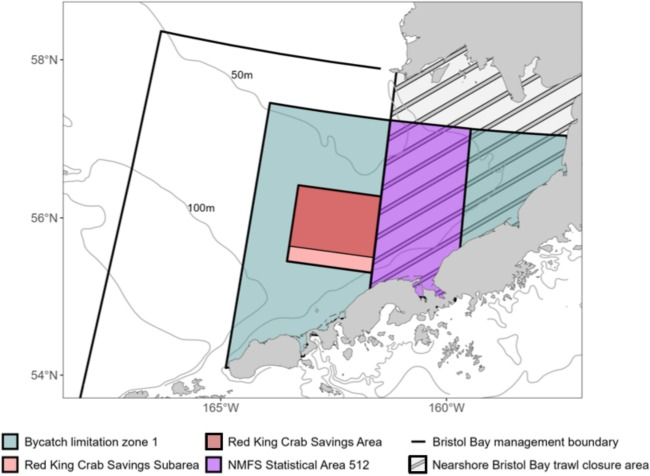
Image credit: ScienceDirect.com
The report on page 26 states: “The contact adjustment for a Bering Sea pelagic trawl CV tow is drawn from a range spanning 0.2 to 0.6 with a median of 0.4. In other words, actual bottom contact would be estimated at a value between 20% and 60% of the raw area swept, where raw area swept is a function of tow length and adjusted nominal width. The contact adjustment for pelagic CPs is drawn from a higher range. During the A Season the contact adjustment for CPs is drawn from 0.7 to 0.9, reflecting an assumption that pelagic gear is on bottom at least 70% of the time. During the B Season the range is from 0.8 to 1.0.” (80-100%)
The revelation raised eyebrows and prompted Stephanie Madsen, then executive director of the At-sea Processors Association to say: “It is an estimate” and “not proven” and “It has been known all along by many.”
NOAA’s Office of Law Enforcement (OLE) admitted in a 2023 report that current pelagic trawls are being fished on the bottom and there is little they can do about it — because the gear doesn’t fit the regulatory definition in the federal rule books. The definition of the gear has not been changed since 1993.
In June 2026, now going on five years, the NPFMC continued its request for more “discussion papers” to identify “options for viable and enforceable mechanisms to reduce bottom contact.”
But they added that any benefits will be weighed against harm to the pollock fishery.




