
By Peter Bradley at Medium.com
September 6, 2023
Alaska is quietly permitting major on-shore fish processors like Silver Bay Seafoods and Trident Seafoods to dump thousands of tons of seafood waste at the mouths of bays, rivers, sounds, and inlets. Meet the Gut Boats of Alaska.

For several years now, these sorts of stories have been bubbling up for Alaska’s largest seafood processors:
“Trident Seafoods has agreed to pay a $300,000 penalty and remove an underwater pile of seafood waste near Sand Point in a settlement with the federal government involving Clean Water Act violations…”
– Alex DeMarban for Anchorage Daily News on March 1, 2018.“Federal regulators have fined a Sitka seafood processor for allowing its waste pile on the seafloor to balloon to more than double the size allowed by its permit. […] The federal agency accused Silver Bay Seafoods of violating the Clean Water Act by dumping excess blood, oily waste and foam into the water. […] It now appears to have addressed the problem. The company paid a $82,500 penalty and is opting to put a screen on its waste pipe to reduce the volumes it discharges.”
– Jacob Resnick, Coast Alaska (Juneau), on Nov 6, 2019
Both stories linked above, and others besides, were about the underwater piles of fish waste that had accrued in waters beneath the outflow pipes from the processing plants. As far as the rules for these things have stated for years, the seafloor waste isn’t supposed to occupy more than an acre, the annual discharge into that acre isn’t supposed to exceed 10,000,000 pounds, and the chunks that go down are supposed to be 1/2″ or smaller. For some processors, those constraints would have been limiting, had they been adhered to at all. But the constraints are important because the hazards of piling up fish waste have been known for many decades. In a notice on Alaskan Seafood Processing Effluent Limitations Guidelines in 2013, the EPA partially described the problem:
“Fish processing waste piles from land-based facility discharges cover large areas of the seafloor and contain large quantities of solids that negatively affect receiving water quality. These piles range in area, sometimes covering tens of acres. They can grow to many feet thick. (DCN 00201). The waste piles smother benthic (bottom) communities, deplete dissolved oxygen, and cause other harmful impacts on the aquatic ecosystem. In some cases, large waste piles at outfalls (both active and inactive) do not dissipate, even with flushing from tides and strong channel currents. Where discharges have stopped, fish waste piles and their effects can remain for 10 years or more.”
Stories of oversized fish piles beneath plants left me wondering: where do you remove an underwater pile of seafood waste to? and, what happens to the stuff that doesn’t make it through the new screen of the waste outfall pipe?
Where I looked for information
Towards answering the above questions, I used:
- EPA’s Enforcement and Compliance History Online (ECHO) facility search tool
- Alaska DEC’s Environment Data Management System (EDMS) Site Map Explorer
- The Alaska DEC Seafood Processing webmap and
- The database of AKG523000 permittees (a bit more on this in a moment).
- I corroborated some of what I learned with vessel movements on Global Fishing Watch, and include several images from that resource below.
I was pretty astonished at what I learned: many of Alaska’s largest processors, in several locations, have responded to running out of room for fish waste below their plants by securing an Alaska General Permit for Offshore Seafood Processors Wastewater Discharge (AKG523000) — allowing them to use “gut boats” (also known as gurry boats) to ferry fish waste solids away to designated spots at sea, through a self-monitoring system. The permit links a processing facility to a designated permitted gut boat and a patch of sea to be dumped in, and opens up a new 10,000,000 pound annual dumping allotment for the processor.
So… What’s Happened?
Trident Relocated the Fish Waste Pile at Sand Point
When Trident was asked to clean up the outfall pile by their plant at Sand Point, the agreement that they came up with — as I learned in this waste remediation workplan filed with Alaska DEC — was to dredge up the pile over the course of 45 days and transport it over the course of weeks to a designated area in the center of Popof Strait, right between the 1-mile and 3-mile line:
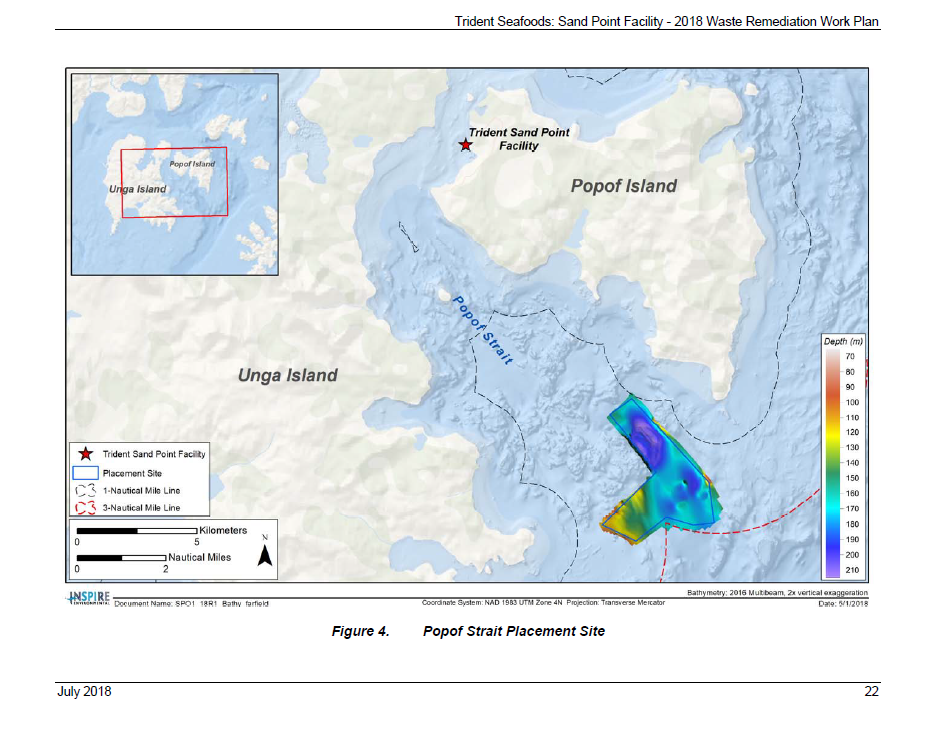
I corroborated that work-plan with Global Fishing Watch, and located the tracks for the Tug Waldo operating through the summer of 2018, as seen below.

Meanwhile, Silver Bay Seafoods Left Their Waste Pile Intact, and Began to Dump New Waste At Sea
The pile of fish waste has been dealt with differently in Sitka, according to documents attached to the recent June 2023 wastewater permit renewal.
The permit documents indicate that a seafloor survey “completed on 10/16/2022 found 2.20 acres of Zone of Deposit coverage”. The oversized pile wasn’t shrinking. Included in the permit application was the Seafood Wastewater Source Control Proposal for the plant outfall, including the plan for the oversized pile. Their approach, in practice as in the plan, is to leave the pile as it is, and use gut boats — they call them gurry boats — during peak season. Outside of peak season, waste may be avoided by operating a pet food line for parts of the year, but that will be shut down for peak seasons. They explain: “The material that would normally become the pet food product will be downsized to less than ½” and diverted directly to the gurry vessel, bypassing the facility waste conveyance system and screen plant.”
As they tell it in the Seafood Wastewater Source Control Proposal, Silver Bay Seafoods started using the gut boats in Sitka in 2019, when “A Compliance Order on Consent was issued by the EPA prohibiting the discharge of solid waste through Outfall 001 and requiring annual seafloor monitoring within 90 days of the completion of the salmon processing season until the reduction of the ZOD to less than or equal to 1.0 acres for two consecutive years.” Since then, many thousands of tons of waste have been transported by gut boats under multiple Alaska DEC permits to changing locations in Eastern Channel, and now, farther out, with permission from the EPA.


And so to those questions — where do you remove an underwater pile of seafood waste to, and what happens to the stuff that doesn’t make it through the new screen of the waste outfall pipe at the plant? Well, it turns out that in Alaska, the answer to both questions has become the same: you expand the territory for dumping.
Gut Boats Working Elsewhere in Alaska
These are some of the gut boats that have been working in Alaska in recent years.


The above images are not exhaustive, and it appears that more processors are electing to acquire AKG523000 permits to begin dumping waste by boat. The Kodiak Fishmeal Company — which receives the waste from several Kodiak processors — Trident Seafood, Pacific Seafood, Silver Bay Seafoods, Ocean Beauty Seafoods, and North Pacific Seafoods plants — has lined one up that they haven’t used yet. In the Outfall Narrative of their permit application, they wrote it would be used “on a contingency basis in the event that the KFC facility is offline (i.e., unable to process fish wastes), or does not have the capacity to process all of the fish by-products produced during fish processing season”.
It’s an important trend to pay attention to, as many of Alaska’s fish processors are running out of dumping grounds at their current spot. The processors are failing to use the whole product, especially at peak times, and are intensely polluting with fish waste as a result. To highlight the risks of doing this, I’ll quote at length from a 2021 article in the Journal of Environmental Chemical Engineering:
“The environmental concerns associated with disposal of fish wastes into ocean waters include reduced oxygen levels in the seawaters at the ocean bottom; burial or smothering of living organisms; and introduction of disease or non-native and invasive species to the ecosystem of the sea floor. During rainy season, seepage of water through the landfill dump causes additional problems. Nutrients, suspended solids, disinfectants and possible coliform bacteria from the seafood industry effluents affect coastal water quality and hence human life, particularly in the coastal regions. Hypoxia is a condition of low oxygen in the water than can kill fish and other aquatic animals. High level of BOD may cause hypoxia in a receiving environment, leading to anoxia, a condition characterized by an absence of oxygen supply to an organ or a tissue of living organisms. The high levels of nitrogen, phosphorus and FOG may lead to shortage of drinking water, eutrophication (growth of unwanted biota), biotic depletion, algal blooms, habitat destruction, water acidification, disease outbreaks and possible extensive siltation of corals.” — from Venugopal, V., & Sasidharan, A. (2021). Seafood industry effluents: Environmental hazards, treatment and resource recovery. Journal of Environmental Chemical Engineering, 9(2), 104758. https://doi.org/10.1016/j.jece.2020.104758
To illustrate the scale of the issue, a search of EPA’s ECHO tool for facilities belonging to a grouping of major seafood processors in Alaska returns 83 facilities, 55 of them with current violations.

Many of those violations have to do with things like exceeding permitted seafloor area, exceedences of (usually) 10,000,000 lb dumping allowances, outflow lines breaking near shore, or problems and gaps with self-reporting. I’m writing this to flag that many major processing plants appear to be running in a near-chronic state of violation of regulations… and gut boats are increasingly part of it.
After diving deep into the recesses of the EPA and Alaska DEC websites this week, I’ve realized that regulatory practice around this has changed — without a whisper — to more totally accommodate processors in extreme wasting during peak season, and to make allowances for violations.
Instead of one permit for one outfall pipe, a processor can now have multiple permits for multiple gut boats. Suddenly, a new immensity of fish waste is being allowed to be produced and dumped, farther from the plants but still in nearshore waters, sapping oxygen from surrounding waters while adding other chemical byproducts to the mix, spreading ill effects, promoting new zones of oxygen depleted waters.
This emergent dumping practice begs the question: is it really bad, or simply offal?




